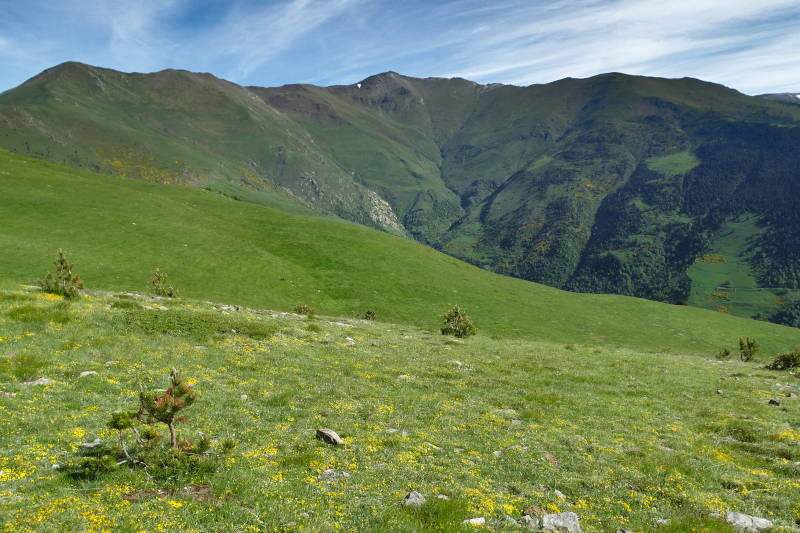
Walking routes through Ripollès
The best walking routes in Ripollès, excursions and botanical hiking routes
Ripollès is known for being the cradle of Catalonia, for its monasteries, for its livestock fairs and for its traditional cuisine. But undoubtedly, Ripollès is a Pyrenean region with a great hiking tradition, where we find some of the most emblematic peaks of Catalonia, a small paradise for mountain lovers.
Ripollès is located very close to Barcelona , an hour and a half bycar andaccessible by public transport ,bus or train .
Upcoming scheduled outings to discover Ripollès
Click on the image for more information about the route.



Well, here are the next walking routes through Ripollès that you can do with Muntanya i Natura, and if that's not enough, we'll make you a personalized route wherever you want, with whoever you want and whenever you want! Let us know!
Guided routes in Ripollès
Ripollès is the ideal place for a weekend getaway , family walks, long-term excursions , a day trip or to spend your holidays there at any time of the year. A destination to disconnect, breathe fresh air, taste traditional cuisine and its artisan products, enjoy nature and go mountaineering.
Ripoll , the capital of the region, is located at the confluence of the Ter and Freser rivers, the confluence of the three territories that form the Ripollès: the Ribes valley, the Camprodon valley and the Baix Ripollès.

The Ribes Valley or Freser Valley is located in the northwest of the region and includes the municipalities of Queralbs, Ribes de Freser, Campelles, Pardines, Planoles and Toses. It is a Pyrenean territory that includes the highest point of the region, the Puigmal. Ribes de Freser is located in the center of the valley and is at the confluence of the three rivers that form it: the Freser, the Rigard and the Segadell. It is a valley enclosed between high mountains and steep peaks, with deep gorges and presided over by the Núria Valley and its emblematic Núria Sanctuary. Historically, the Ribes Valley has been part of the county of Cerdanya, which has made it significantly different from the Camprodon Valley and the Baix Ripollès.

The Camprodon Valley or the Alta Vall del Ter, is located in the northeast of Ripollès and includes the municipalities of Camprodon, Llanars, Molló, Setcases, Sant Pau de Segúries, Vilallonga de Ter. It is a Pyrenean valley structured by two large rivers that converge in Camprodon: the Ter which rises at the foot of Bastiments, in the Ulldeter cirque, and the Ritort, which rises on the southeastern slope of Costabona, in Espinavell. In the Camprodon Valley, rounded peaks, pastures and meadows predominate, with a high rainfall that brings a great variety of landscapes, from high mountain landscapes to riverside forests, beech and oak groves, and meadows. In the past, the Camprodon Valley was part of the county of Besalú and the bishopric of Girona, a fact that has marked its uniqueness.

The Baix Ripollès is formed by the municipalities of Campdevànol, Gombrèn, les Llosses, Ogassa, Ripoll, Sant Joan de les Abadesses and Vallfogona de Ripollès and encompasses the pre-Pyrenean territory of the south of the region. Vertebrated by the Ter river and the lower part of the Freser, it is a territory formed by cultivated plains and extensive forests of beech, oak and Scots pine. It is where the capital of the region is located: Ripoll, and the main industries and services of the region. Its past was notably influenced by Guifré el Pelós and the county of Osona, and monuments such as the monastery of Santa Maria de Ripoll and that of Sant Joan de les Abadesses stand out.

Guided routes in the natural spaces of Ripollès
Ripollès is located on the southern slope of the Eastern Pyrenees and the southern limit of the region coincides with the Pre-Pyrenees mountain ranges. It is a very mountainous territory that includes a wide network of protected natural spaces with a remarkable biodiversity and a great landscape contrast that makes it very attractive for lovers of hiking, mountaineering and nature. Its altitudinal range that goes from 2,909 meters at the summit of Puigmal to 350 m at the lowest point in the municipality of Beget. The Natural Park of the Ter and Freser Headwaters, the most emblematic peaks, the sanctuary of Núria, Ulldeter, the Romanesque monasteries and hermitages, the forges, the iron and coal mines, the shepherds, the cattle, the flocks, the transhumance, the rivers and the factory colonies are part of the important heritage of Ripollès.

The Ter and Freser Headwaters Natural Park encompasses the headwaters of the Ter and Freser rivers, in the axial Pyrenees, and is where the highest peaks of Ripollès are found, Puigmal with its 2,909 meters, Bastiments or Pic de l'Infern. Thanks to the significant altitudinal gradient and its proximity to the Mediterranean Sea, it contains a great wealth of flora and fauna, with some endemic species and others in danger of extinction. Coma de Vaca, the Núria Valley or the Ulldeter Cirque are good examples of the glacial modeling that sculpted this part of the Eastern Pyrenees.

The Rasos de Tubau Protected Natural Area is part of the Eastern Pre-Pyrenees and is located south of Ripollès, encompassing part of the Berguedà territory. The mountain range is made up of conglomerates, sandstones and clays and stands out for its extensive forest cover, which means that there is a small relict population of the black grouse, a threatened and endangered species. The Pedró de Tubau, located at an altitude of 1545 m, is the most prominent point.

The Serra Cavallera Protected Natural Area is a pre-Pyrenean mountain range located transversely in the middle of the Ripollès region, between the Freser valley and the Camprodon valley. It is notable for the richness and diversity of Central European deciduous forests, exceptional beech and oak forests, Scots pine forests, and subalpine meadows. The highest point is Taga, located at 2,032 meters above sea level.

The Riberes de l'Alt Ter Protected Natural Area is a fluvial area that encompasses the banks of the Ter River from Camprodon to Ripoll, a section of the Ritort River and some plains and wooded areas of the valley bottom. It stands out for being an environment of permanent waters with well-preserved riparian forests and gallery forests.

The Serra de Montgrony Protected Natural Area is the continuation of the pre-Pyrenean mountain range that goes from Puigllançada to Freser, in Ribes de Freser. It is a forested area with a limestone nature and a remarkable biodiversity due to having two well-marked slopes, the shady and the sunny. The Montgrony sanctuary and the Costa Pubilla, the highest peak, at 2,056 meters, stand out.

The Protected Natural Area of the Obagues de la Vall del Rigat extends from Toses to Ribes de Freser following the course of the Rigat river and up, through the Rigat grove, between Planoles, Campelles and Ribes de Freser. This area, eminently fluvial, is characterized by being a good representation of the low and humid groves of the Montgrony mountain range, formed by important mixed deciduous forests, and the very well-preserved riverside forest.

The Serra de Milany, Santa Magdalena and Puigsacalm – Bellmunt Protected Natural Area is located in the southeast of Ripollès, bordering the regions of Osona and La Garrotxa. It is the most notable and representative natural area of the Transversal system, along with Collsacabra, and the most important of the eastern pre-Pyrenean mountains of the Levant. The mid-mountain landscape stands out mainly, formed by deciduous forests of a Central European character thanks to its humid climate and the great diversity of forest flora and fauna. The Vallfogona stream or the Milany castle are good examples.

The Alta Garrotxa Protected Natural Area is one of the most important natural areas in the eastern Pre-Pyrenees of the Levant, due to its diversity of landscapes and environments, uniqueness and relative geographical isolation that has led to a good state of conservation. It encompasses an extensive area basically limestone that belongs to the counties of Ripollès, Garrotxa and Alt Empordà. It is characterized by being a forested, abrupt territory, of a wild nature, formed by numerous valleys, cliffs and cliffs, with small isolated population centers. This isolation has led to the presence of numerous endemic species, both of flora and fauna. Part of the municipalities of Camprodon, Sant Pau de Segúries and Molló, in the Camprodon valley, are part of the area.

Walking routes through Ripollès
Muntanya i Natura offers you a wide range of walking excursions through Ripollès, guided routes and ascents to peaks, so that you can discover the wealth of landscapes, the great biodiversity, the flora and fauna, the forests, the most emblematic peaks and the unique places of this Pyrenean region located very close to Barcelona.
In this collection of walking routes through Ripollès you can discover castles and cross-border paths .
-
Enjoy high mountain landscapes , lakes of glacial origin, forests and subalpine meadows where you can discover endemic and unique flora .
-
You will also be able to discover the habitat of several exceptional faunal species, such as vultures , bearded vultures , mouflons , marmots and chamois .
-
If you like history and want to know how people lived in these areas years ago, you can walk along livestock paths , discover charming villages and old pastoral settlements .
-
Or maybe you are a lover of Romanesque art, because you will find walking routes through Ripollès to learn about the history of Romanesque monasteries and hermitages .
-
And if you are one of the more sporty types and like to climb peaks, then you will also find ascents to emblematic peaks along less frequented routes such as Puigmal , Freser , Les Borregues , Costa Pubilla and Balandrau . And also mountain treks of 2, 3 and 4 days and of different levels.
Why go with a Mountain and Nature guide?
Well, because we are qualified mountain guides and good connoisseurs of the Capçaleres del Ter i del Freser Natural Park, we also love our land and believe that tourism must be sustainable and responsible with the territory where it is carried out, which is why we are one of the first 10 companies in the process of adhering to the European Charter for Sustainable Tourism in Ripollès.

What is CETS?
The European Charter for Sustainable Tourism (CETS) is a practical management tool defined by the Europarc Federation that helps protected natural areas to continuously improve the development of tourism activity, taking into account the needs of the environment, the local population, local tourism businesses and the needs of tourists and visitors. The objective of the CETS is to protect and enhance the natural heritage of protected areas and Natura 2000 Network areas, by promoting an innovative model of sustainable tourism planning, which reduces conflicts of use, maintains social and territorial cohesion, improves the quality of life of local communities and encourages the contribution of the tourism industry to nature conservation.
The process of adhering to the European Charter for Sustainable Tourism is divided into three phases, including the different agents in the territory.
In October 2019, the Ter and Freser Headwaters Natural Park was accredited with the European Charter for Sustainable Tourism by the Europarc Federation.
At the end of 2022, the second Phase began, where tourism companies and territory managers interested in maintaining a close relationship with the park and working together based on mutual commitments established to develop sustainable tourism in the territory are accredited.
More information: Ter and Freser Headwaters Natural Park
Mountain and Nature membership process
Currently (2022), ten companies, including restaurants, tourist accommodations, tourism offices, etc., are carrying out the necessary procedures to obtain this accreditation. In the case of companies, the CETS accreditation period is valid for 3 years.
Muntanya i Natura is one of these 10 companies that has started the accession process. Currently (2022), we are submitting all the necessary documentation, applying the requirements and formulating the program of actions that must be implemented over the next 3 years. If all goes well, by the end of the year (2023) we will be a company affiliated with the CETS within the Natural Park of the Ter and Freser Headwaters.
This 2023 we are already a company adhering to the European Charter for Sustainable Tourism!
More information:
What is a good PNCTF Connoisseur?
One of the requirements to join the CETS as a company is to have completed the Good Connoisseur course of the Ter and Freser Headwaters Natural Park and obtain the Good Connoisseur card issued by the Generalitat Parks Network. This training is essential to have a good knowledge of the Ter and Freser Headwaters and to be able to rigorously develop visit and discovery activities with tourist, school and leisure groups in the Natural Park.

Tips and recommendations for visiting natural spaces

Recommendations to make your stay in Ripollès more sustainable
Taste Ripollès! (Local products from Ripollès)
Eat Ripollès! (where to eat in Ripollès)
Rest in Ripollès (accommodations)
Companies adhering to the European Charter for Sustainable Tourism in Ripollès
Discover Ripollès accompanied by a Mountain and Nature guide!
Tailor-made and a la carte outings to discover Ripollès
Click on the image for more information about the route.